
Triturus cristatus
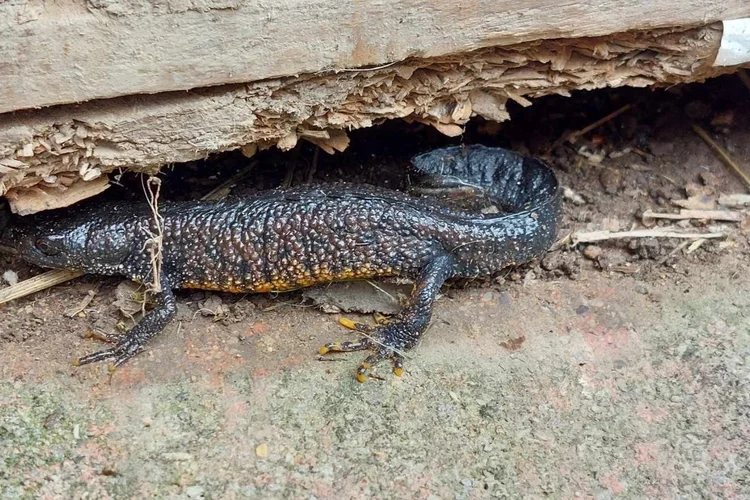
The great crested newt is the largest of our three native species of newt. Adults can grow up to 15cm in length and have very dark skin with a rough, warty appearance. The underside is bright orange with dark blotches and the toes are long with orange stripes. During the breeding season, males have a large crest along their back and a white flash on the tail.
They favour large ponds that have a mixture of open water and vegetation. After mating, each female lays around 200 eggs, individually laid and wrapped inside the leaves of aquatic plants, particularly water forget-me-not (Myosotis scorpioides) and floating sweet-grass (Glyceria spp). Once the breeding season is over, the newts will leave the pond in search of places to hibernate and will frequently be found under refugia, in burrows and tree roots.
The great crested newt is the largest of our three native species of newt. Adults can grow up to 15cm in length and have very dark skin with a rough, warty appearance. The underside is bright orange with dark blotches and the toes are long with orange stripes. During the breeding season, males have a large crest along their back and a white flash on the tail.
They favour large ponds that have a mixture of open water and vegetation. After mating, each female lays around 200 eggs, individually laid and wrapped inside the leaves of aquatic plants, particularly water forget-me-not (Myosotis scorpioides) and floating sweet-grass (Glyceria spp). Once the breeding season is over, the newts will leave the pond in search of places to hibernate and will frequently be found under refugia, in burrows and tree roots.
Great crested newts play important roles in their ecosystems by contributing to several key functions:
Predator and Prey Roles
- As predators, they help control populations of invertebrates like insects, worms, and small aquatic organisms, maintaining balance in pond ecosystems.
- As prey, they are a food source for birds, fish, mammals, and larger amphibians, linking lower and higher parts of the food web.
Nutrient Cycling
- By feeding and excreting both on land and in water, great crested newts help transfer nutrients between terrestrial and aquatic environments, enriching soils and ponds.
Habitat Structuring
- Their breeding activities (like laying eggs on aquatic plants) and foraging behavior can subtly influence the structure of pond vegetation and microhabitats, affecting other species that share the ecosystem.
Biodiversity Indicators
- Because they are sensitive to pollution and habitat degradation, great crested newts act as bioindicators — their presence usually signals a healthy, biodiverse environment.
Support for Other Species
- The ponds and terrestrial habitats managed for great crested newts benefit many other species, from dragonflies to water beetles to small mammals.
In short, great crested newts contribute to food web stability, nutrient flows, habitat diversity, and biodiversity conservation.
Due to the decline in numbers over the last century, great crested newts have full legal protection under UK law making it an offence to kill, injure, capture, disturb or sell them, or to damage or destroy their habitats. This law refers to all life-stages, including their eggs.
Habitat loss is one of the biggest threats faced by these magnificent creatures and so in 2024 we restored three ponds on Deer Park. [link to wetland restoration project]. It is our hope that these ponds will provide a vital habitat for these newts, and other amphibians, to thrive.
Further information can be found here: